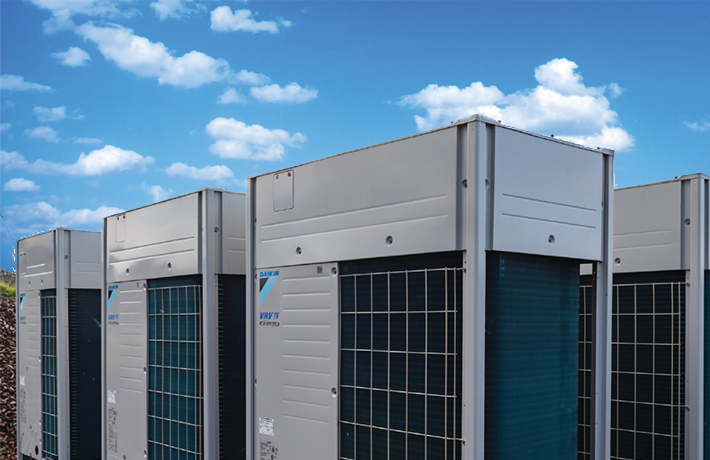
VRV systems use inverter-driven compressors to continuously adjust refrigerant flow based on real-time demand. Each indoor unit receives only the capacity it needs, ensuring comfort without wasted energy.
VRV systems are especially effective in commercial buildings with multiple zones and varied load patterns, providing efficient, individualized comfort. They are often selected where comfort flexibility and efficiency are top priorities.
VRV systems are known for their high efficiency and precise comfort control. By matching output to demand, they minimize energy waste while improving occupant satisfaction.
Environmental Air Systems provides complete VRV and VRF system services across the full equipment lifecycle. As a Daikin authorized dealer and certified installer we have specific training and diagnostic tools for Daikin VRV systems, and we service all other major VRF brands as well.
VRV systems require specialized design, engineering, and installation expertise. Environmental Air Systems works with commercial clients to evaluate system suitability, plan controls, and provide full lifecycle support. Our family-owned approach means we combine technical depth with personal service, ensuring your system is reliable, efficient, and tailored to your facility’s needs.
Contact Us About VRV Systems
At Environmental Air Systems, we design, install, and service commercial VRV systems to meet your building’s unique needs. From zone analysis and system integration to professional installation, commissioning, and ongoing support, we ensure your VRV system delivers precise comfort, energy efficiency, and long-term reliability.
Call 732-681-0856 or Request a Quote to learn how we can help you leverage VRV technology for greater comfort, efficiency, and control.
Have more questions? Give us a call — our team is always happy to help.
View All FAQsThese systems use a single large outdoor unit connected to multiple indoor units with an inverter-driven compressor that continuously adjusts refrigerant flow to match each zone's demand precisely. VRV and VRF refer to the same technology — the terms differ by manufacturer. Daikin uses VRV; most others use VRF. Daikin trademarked VRV when they invented it in 1982, so competing manufacturers use VRF.
A standard split connects one outdoor unit to one or a small number of indoor units with fixed-capacity operation. A VRV/VRF system connects one large outdoor unit to many indoor units — often 10, 20, or more — with variable refrigerant flow control allowing each zone to operate at different temperatures simultaneously and independently.
VRV/VRF systems are generally most cost-effective for commercial buildings with 5 or more zones requiring independent control. Office buildings, hotels, medical facilities, mixed-use developments, and multi-tenant commercial properties are the most common applications in New Jersey.
VRV/VRF systems are among the most energy-efficient commercial HVAC technologies for multi-zone applications. Their variable-speed compressor technology precisely matches output to demand, and heat recovery capability allows simultaneous heating and cooling in different zones using energy that would otherwise be wasted.
As a Daikin authorized dealer we have specific expertise with Daikin VRV. We also install and service Mitsubishi Electric VRF, Fujitsu VRF, and other major VRF platforms.

Have more questions? Give us a call — our team is always happy to help.
View All FAQsA CRAC unit is a precision cooling system specifically designed for technology environments. Unlike standard comfort AC with wider temperature tolerances, CRAC units maintain very tight temperature and humidity ranges, operate continuously under constant heat loads, and prioritize sensible cooling — removing heat rather than dehumidifying.
Standard commercial AC tolerates temperature swings and cycles on and off normally. Computer room cooling maintains temperature within a degree or two continuously, operates 24 hours a day 365 days a year, is sized for high sensible heat loads from electronic equipment, and typically includes redundant capacity so a single unit failure doesn't cause a cooling outage.
ASHRAE recommends inlet air temperatures at server equipment of 64.4°F to 80.6°F, with a practical operating target of 65°F to 75°F for most NJ facilities. Temperatures above 80°F increase equipment failure rates and thermal throttling.
ASHRAE recommends 20–80% relative humidity with a practical target of 40–55%. Too low creates static electricity risk. Too high creates condensation risk. At the Jersey Shore where summer outdoor humidity regularly exceeds 80%, proper humidity control in server rooms is particularly important.
Semi-annual service is the recommended standard for most mission-critical computer room cooling installations, spring and fall. Given continuous operation and zero-tolerance requirements, annual service intervals are generally not sufficient.